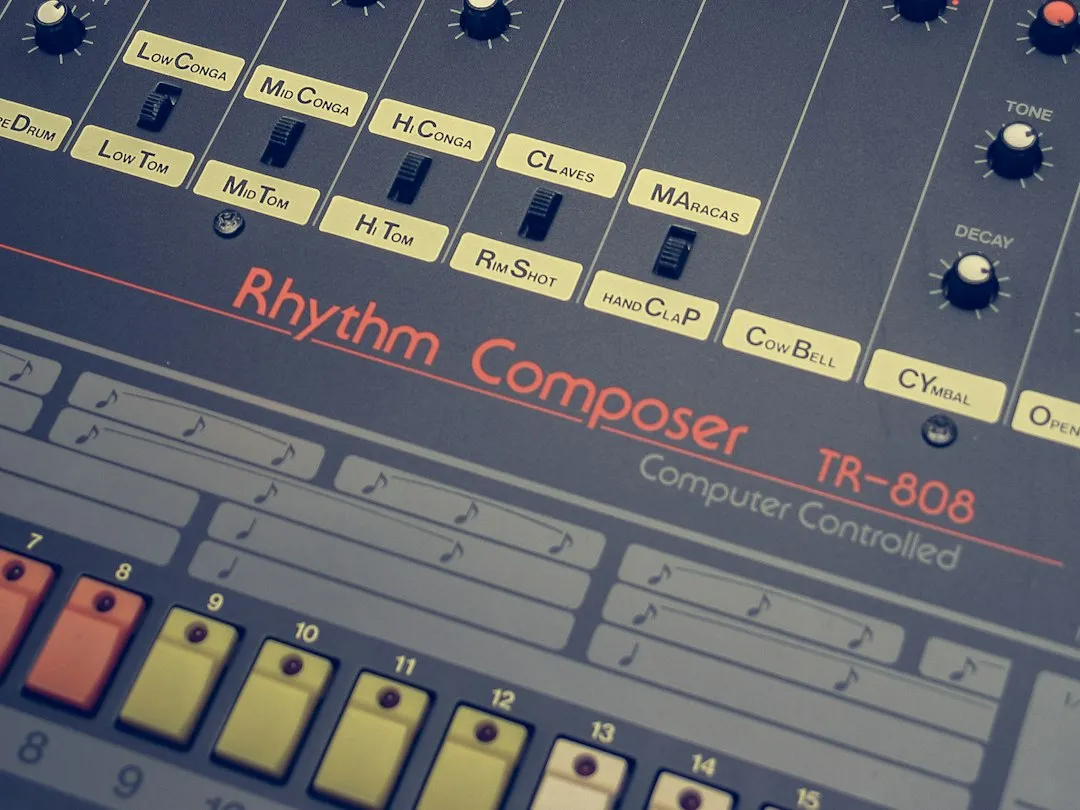
Think about the bass that rattles your rearview mirror. That long, round, chest-thumping boom? Odds are it traces back to a drum machine from Japan that was never supposed to change American music. The Roland TR-808 is the most influential drum machine in hip-hop history, and its story says a lot about how this culture works: we take what gets passed over and make it essential.
Today, “808” is a word everybody uses, from bedroom producers to veteran engineers. Sometimes it means the actual machine. Sometimes it just means a heavy sub-bass sound. Either way, it is the foundation of how rap, R&B and trap feel in your body.
Here is where the 808 came from, how it landed in the hands of early hip-hop and electro pioneers, how the South made it a regional signature, and what producers can still learn from it today.
A Machine Built for Somebody Else
Roland introduced the TR-808 Rhythm Composer in 1980. It was designed as a practical tool for songwriters and musicians who needed a rhythm track to play along with, not as a revolution in a box. Instead of playing back recordings of real drums, it generated its sounds with analog circuitry.
That is exactly why it did not sound like a real drummer, and at the time that was seen as a weakness. The machine did not stay on the market for long before Roland moved on to newer gear. Secondhand units became easier to find and easier to afford.
Cheap, available and strange: that is a recipe the culture has always known how to use. Hip-hop was born from turntables, mixers and records repurposed in ways nobody planned, so a drum machine with a personality of its own fit right in.
From Planet Rock to the Block Party
The 808 showed up across pop and R&B early. Marvin Gaye’s 1982 record “Sexual Healing” is one of the best-known examples of its sound in soul music. That matters, because it shows the machine was never only a rap tool. It lived in the bloodline of Black music from the jump.
Then came “Planet Rock” by Afrika Bambaataa and the Soulsonic Force, also from 1982, produced with Arthur Baker and John Robie. It fused the machine’s sharp, futuristic rhythm with the energy of the Bronx, and the result changed what a hip-hop record could sound like. Electro and early hip-hop were practically neighbors, and the 808 was the shared language.
On the West Coast, Egyptian Lover became one of the artists most closely associated with the machine, building a whole sound around it. In Miami, bass music pushed the low end even further, turning car systems into instruments. Different cities, same weapon.
Why the 808 Sounds Like That
The magic is in the kick drum. The 808 kick is a synthesized tone that starts with a punch and then rings out in a deep, smooth tail. Stretch that decay out and the kick stops being just a drum and starts acting like a bassline.
This is the secret behind the modern 808. Producers realized the kick had a musical pitch, so they could tune it to the key of the song. A kick that fights the melody sounds muddy, while one that sits in the key feels like the whole record is breathing with it.
The rest of the kit has its own character too. The snare, the clap, the toms and that unmistakable cowbell all sound synthetic in the best way, and the hi-hats are crisp and clipped. None of it pretends to be a live band. It sounds like the future, and that was the point.
The South Takes the 808 Global
If New York, Los Angeles and Miami introduced the 808 to hip-hop, the South made it a way of life. Producers in Atlanta, Houston, Memphis and New Orleans leaned into the low end like never before. Mannie Fresh, Three 6 Mafia, Lil Jon and the Atlanta wave of the 2000s each pushed the sound in different directions, but the bass was always the star.
Trap took that foundation and added rapid-fire hi-hat patterns, sliding bass notes and a darker mood. Those glides, where one 808 note bends into the next, turned the bass into a lead voice. You can hear its influence on rap, R&B, pop and even film trailers.
Kanye West’s 2008 album 808s & Heartbreak put the machine’s name right on the cover and showed how emotional it could sound. The same drum machine that powered party records could also carry vulnerability. That range is why it never went away.
What Producers Can Learn Today
You do not need the original hardware to learn from it. Plenty of software and sample packs recreate the sound. What matters is the thinking behind it.
- Tune your 808. Match the bass note to the key of your track so everything locks together.
- Give it space. If the kick and the bass collide, one of them has to move. Decide which one leads.
- Think about small speakers. A little saturation adds upper harmonics so your bass can still be heard on phones and earbuds.
- Use restraint. Some of the hardest records ever made leave room for silence between the hits.
Most of all, treat the 808 as an instrument, not a preset. The producers who made history with it learned its quirks and built their identity around them.
The Heartbeat That Never Left
The Roland TR-808 started as a modest tool and became the pulse of a global culture. It moved from soul records to Bronx block parties, from Miami car systems to Southern trap houses, and it still sets the tone for what we hear today. Every generation has found something new in it, which is the clearest sign of a true classic.
So next time that low end shakes your speakers, remember the lineage behind it. Drop a comment with the 808-driven record that changed how you hear music, share this with a producer in your circle, and keep the legacy loud. Listen live on Hoodz Radio.


Leave A Comment